
February 28, 2026
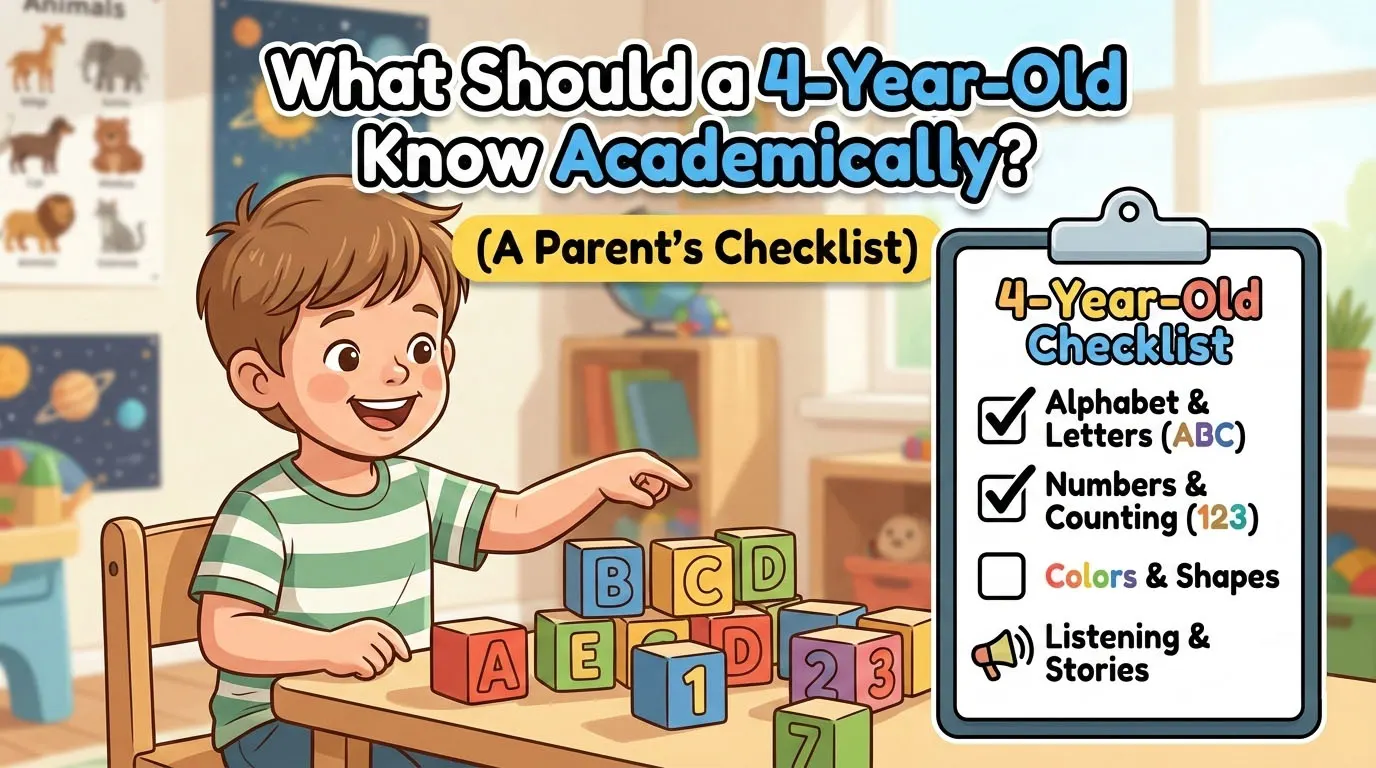
Turning four is a magical milestone. It is the age where toddlers transition into “big kids,” filled with curiosity, questions, and endless energy.
As a parent, it is natural to wonder:
Is my child ready for school?
What should they actually know by now?
1. Language & Communication Skills 🧠
Communication is the bridge to learning. By age four, many children can:
Speak in full sentences: They can use sentences of 5 to 6 words to clearly express their wants and needs.
Ask and answer simple questions: They understand “who,” “what,” and “where” and enjoy asking “why?”
Use future tense: They understand the concept of time, using phrases like “I will go to the park later.”
Retell parts of stories: They can recall the beginning, middle, and end of a favorite book or recent event.
Follow conversation rules: They are learning to listen when others speak and wait for their turn to talk.
2. Early Literacy Skills 🧠
Early reading begins with a love for books. By age four, many children:
Enjoy listening to books: They can sit for a short story and engage by pointing at pictures or asking questions.
Understand print has meaning: They realize that the words on the page are telling the story, not just the pictures.
Recognize some letters: They can identify the first letter of their name and a few other common letters.
Match sounds with letters: They are beginning to hear that the letter “B” makes the /b/ sound.
Pretend to read: They hold the book correctly and use the pictures to tell the story in their own words.
3. Early Writing Skills✍️
Writing starts with hand strength and coordination. Children build skills such as:
Holding a crayon correctly: They are moving away from a fist grip to using their thumb and fingers (tripod grip).
Drawing simple shapes: They can copy basic shapes like circles, squares, and crosses.
Writing their name: They may write their first name, even if some letters are backward or uneven.
4. Early Math Concepts➕
Math is about more than just counting. Foundational skills often include:
Counting objects to ten: They can point to items one by one and count them correctly up to at least ten.
Recognizing numbers: They can identify written numerals (like seeing a “5” on a bus) in the real world.
Recognizing shapes: They can name common 2D shapes like circles, squares, triangles, and rectangles.
Comparing quantities: They understand concepts of measurement, using words like “more,” “less,” “bigger,” and “smaller.”
Sorting objects: They can group items together based on a single rule, such as color, size, or shape.